The 2023/24 season will be the last version of the Champions League in its current form. Beginning next season the eight groups of four teams will vanish and in their place a 36 team Swiss league system will take its place for 2024/25. Quite how this will work out is still unclear but with the group stage largely a precession these days for most of the elite clubs, change may not be a bad thing.
Yet many still pine for the days before 1992. Before the European Cup became the Champions League. Before 1997 when non-Champions were admitted. Before group stages. What would the 2022/23 season have looked like had it been run on the old format?
Just for fun, here's my prediction. The 1967/68 season has been used to provide a framework for the draw. Unfortunately the map of Europe has changed somewhat in that time so there have been a few omissions but none, that would have likely affected the overall impact.
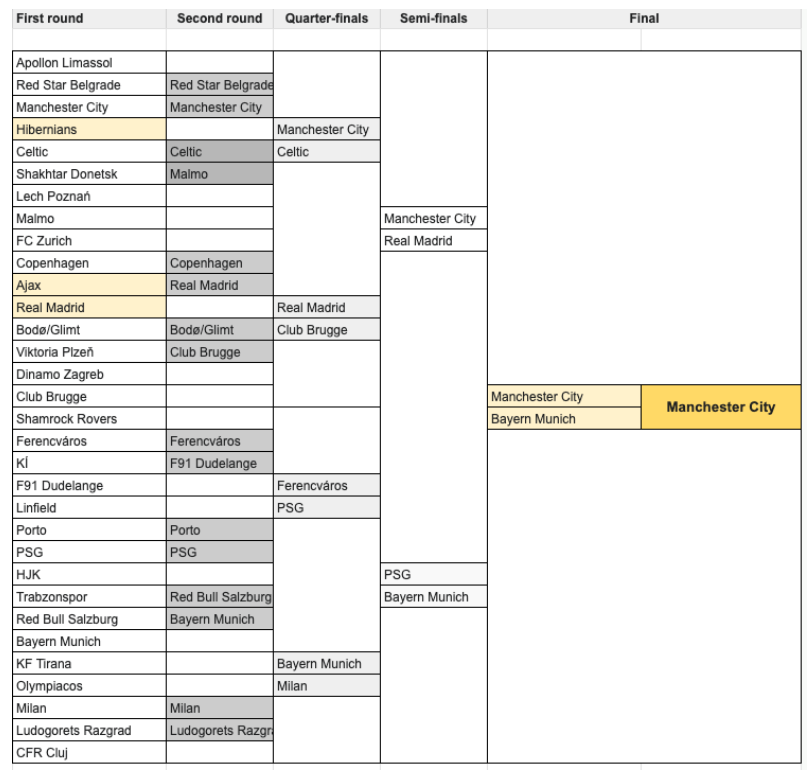
So what changes? Well, not a lot. Hibernians of Malta, Ajax and Real Madrid retain the exact same spots they did in the summer of 1967 with the latter two meeting in the first round. History would likely repeat itself with Real Madrid moving forward.
Celtic and Shakhtar did meet in the 2022/23 season and shared the spoils. I'm plumping for the Hoops under Ange Postecoglou to make it into the Quarter-Finals (after a third game) but find their progress ended in a 'Battle of Britain' against Manchester City. Elsewhere Ferencvaros by dint of a favourable draw and Club Brugge would also reach the last eight but in the end it would be familiar faces in the last four.
Neither of the projected semi-finals need any predicting and nor would the final as they all occurred in the knockout rounds so we can assume Man. City triumph by virtue of their victories over Real Madrid and Bayern Munich respectively.
Is it better? That depends on your point of view. There's certainly more of a mix of teams and leagues represented. With the benefits of a kind draw there's a pathway for a team from one of the smaller nations to make a run to the final, more hope for every team in Europe to become Champions of the continent.
Obviously, none of this takes into consideration the disparities in wealth that have grown over the last fifty years of European football. The Champions League rewards repeat entrants and with the doors much harder to enter its feasible that the wealth of the elite clubs would not be as great and the playing field level to some degree.
But not all of this wealth, is generated from the Champions League. Sovereign states, domestic tv coverage, years of domestic dominance and, in Real Madrid's case, a legacy built in the 1950s, or Bayern's in the 1970s, have had significant impact.
With less games of coursethere would be less tv revenue for the Champions League to share. Would some of the smaller clubs would be willing to trade their guaranteed group stage money for a greater shot at glory.
Unfortunately, I think we probably know the answer.