In my last post, I took a look at the consolidation of power amongst the top five European Leagues, since the formation of the Champions League in 1992. But that doesn't tell the whole story.
Whilst this is a clear distinction to be made between the have and have nots, the concept of a top five league is a bit of a misnomer (aside from the topic of whether France is the fifth strongest league which I covered in my last post). There are tiers within this structure both in terms of clubs and leagues which we will explore further.
Again I have chosen to look at the data from the 99/00 season. This was the pivotal year in which up to four teams from a specific country could qualify. The biggest clubs in each country now had a safety net if they did not win the title. Real Madrid as an example have played in every Champions League season since 1997. Barca and Bayern have missed one season. PSG have now been in every one since 2012.
Spain & England, Germany & Italy
There is a schism within the dominant leagues. England (25.5%) and Spain (26%) have contributed 51% of all knockout teams in these 24 seasons. This drops to 28% for Germany and Italy, around 14% each. Then we have the French at 8% and the Portuguese at 5%.
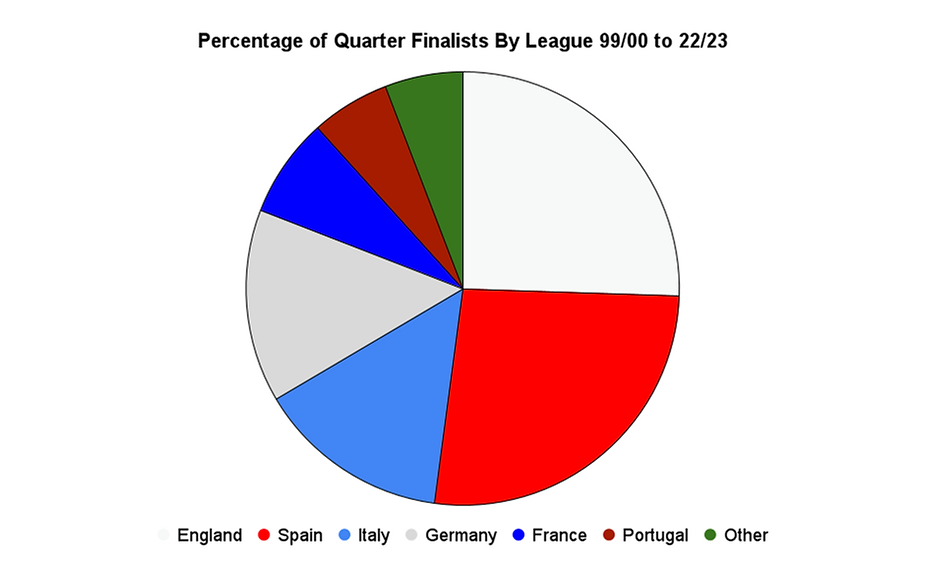
And this has manifested itself in the winners gallery in the last decade. Bayern in 2013 and 2020 are the only non-Spanish or English team to win the Champions League since Inter's win in 2010. A French side has only ever won the tournament once and that was in highly dubious circumstances and though PSG got the final in 2020, they look to have regressed as potential winners in the last few years.
League Variety
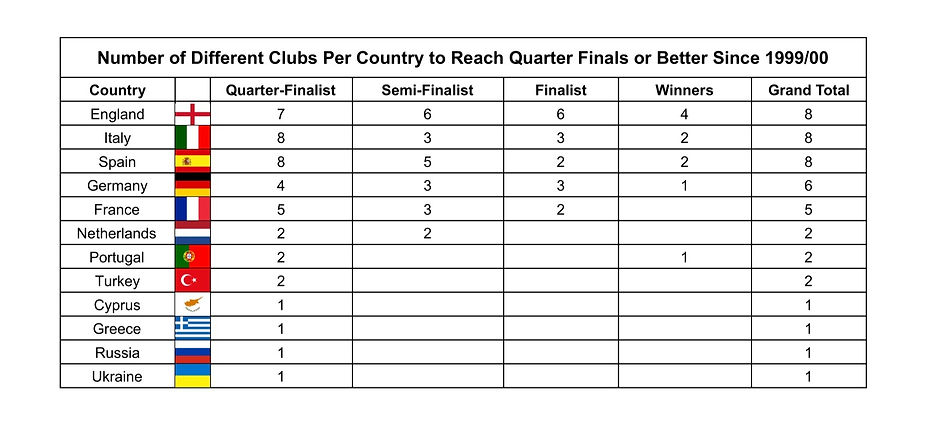
La Liga has by a distance contributed the most Champions League winners in this era (11), a product of two outstanding teams in the Ronaldo-era Real Madrid and Messi’s Barcelona. However the Premier League's assumed collective strength bears true in the data. Four English teams have won the Champions League since 2000 with another two teams (Arsenal & Spurs) reaching the final. Notably three out of the last five winners have been English, with two of those finals being all-English affairs. Valencia and Atletico Madrid have been the other two Spanish sides in the final. Germany and Italy have each contributed three finalists.
The strength of the Premier League has also added another variable, that is getting into the competition. Although it has not held true this season, for most Premier League teams, getting into the top four is probably as hard as than getting into the Champions League Quarter-Finals, unless of course your Manchester United.
Changing Face of the Last Eight
Harry Kane may have pondered his move Germany would almost certainly guarantee himself a Bundesliga title, and well it may, but he would also be just as assured that he would be able to reach the last eight of the Champions League as well. In all but one of the last eleven Champions League seasons, Bayern have reached the Quarter-Finals at a minimum.
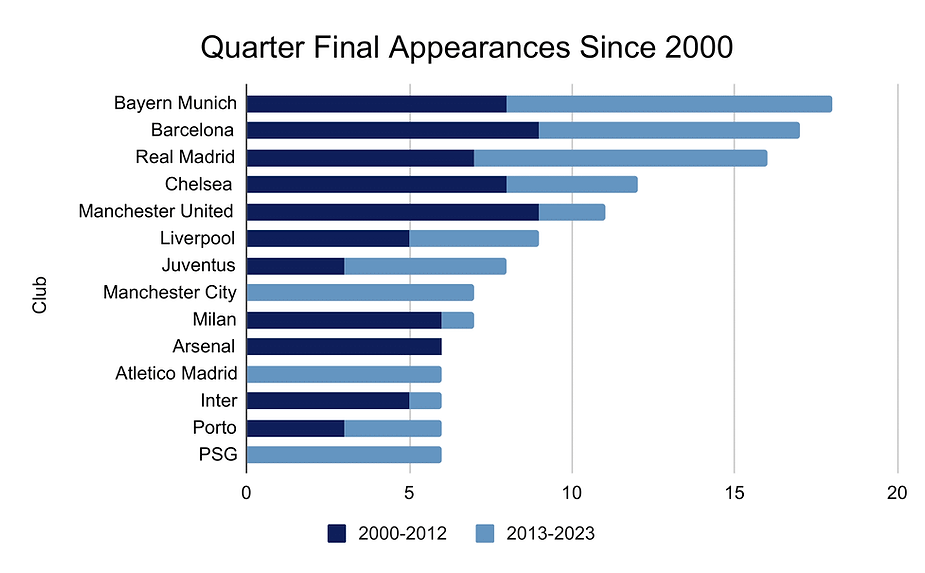
Bayern, Real Madrid and Barcelona (until recent seasons) have remained remarkably consistent in their performances over the past 24 seasons whilst the biggest movers have been unsurprisingly PSG and Man City, but also Diego Simeone's Atletico Madrid, who have established themselves as perennial participants in the latter stages.
On the other hand, Manchester United post-Ferguson have dropped dramatically from being top of the table (tied with Barcelona with nine quarter-final appearances) to a lowly two. For Milan, it's worse, they've only reached the last eight once in the last 10 years.
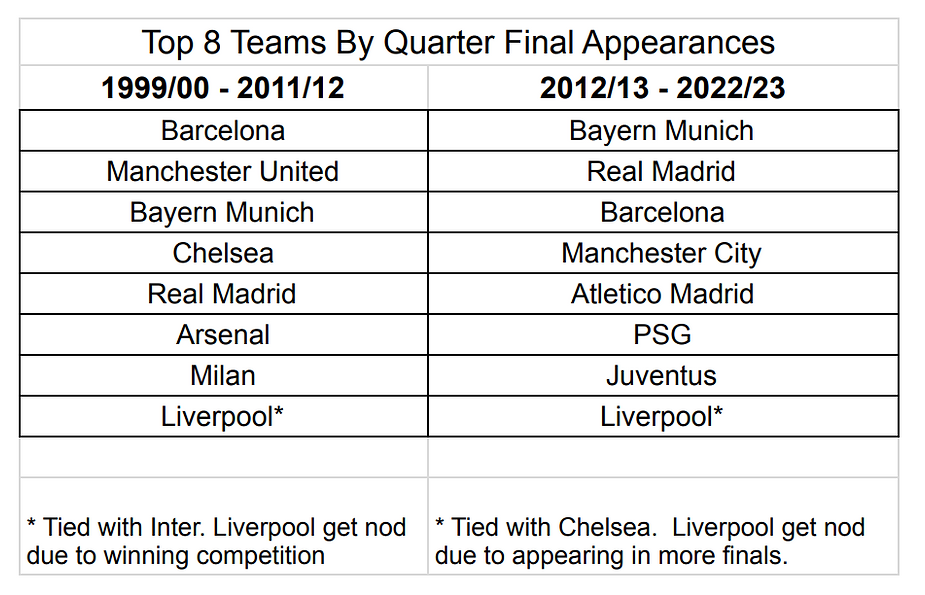
Those eight teams in the right hand column have contributed 72% of the semi-finalists since the 2011/12 season. Add in Chelsea and it's up to 80%, which brings us to our next point.
Winning Teams
Barcelona, Chelsea, Real Madrid, Liverpool, Bayern and Manchester City have shared the last thirteen Champions League titles between them. Though Liverpool and Chelsea won’t feature this season, and Barcelona are still in a state of flux, you’d be hard-pressed to see another club break into that group in 2024. Essentially winning the competition involves hitting form at the right time, gaining a favourable draw or in the case of Real Madrid in 2022 a mix of luck and destiny.
Manchester City this year had essentially earned their right to the title after losing the final in 2021, and throwing away a spot in the final in 2022 in a crazy few minutes at the Bernabeu. The gap between the best and the rest is big enough to ensure that semi-final spots are largely guaranteed, beyond that, it’s so slim that it’s really about the circumstances across the two ties.
It's not impossible to break into this group as the change in the two periods has shown. Arsenal for example have shown improved consistency in the Premier League and if they maintain this there is a good chance they will make a return to the top table on a more regular basis. But they're Arsenal, biggest team in the biggest city in the biggest league in Europe. Outside the Premier League, we have either the state-owned PSG or Bayern, Real Madrid and Barcelona who sit a level above their domestic rivals both in terms of size, talent and success. Juventus during their nine-in-a-row period held a similar position. Their position in the Champions League is almost always guaranteed and it's really on them to mess up not making the last eight.
Domestic Champions
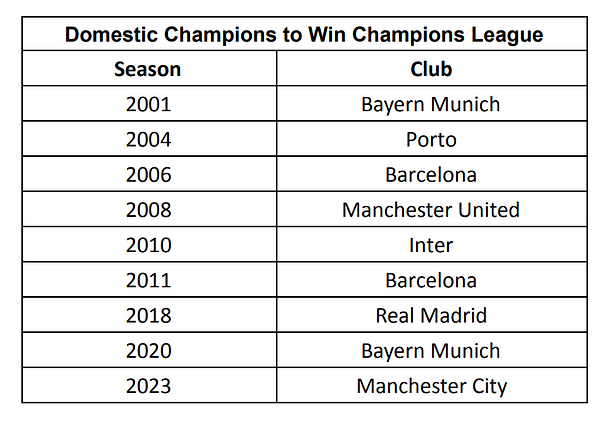
Further illustrating this point is the list of teams who have won the Champions League as reigning domestic Champions. Only 9 out of 24 (37.5%) of winners would have legitimately qualified under the old one club one country system. That's 15 teams who may have had a chance to etch their names in history, but were crowded out of their opportunity.
So What's the Trend?
Well, although history tells us that various leagues go through eras of strength, the concept of a league was only previously able to be tested by virtue of the champions. This can often be confused with success of generational teams. In the modern Champions League era we can see that the Spanish and English leagues are clearly #1 and #2 in the continent.
But we have also entered the era of the Superclub which can be divided into three categories.
- The Dominant National Clubs: Bayern, Real Madrid, Barcelona, Juventus
- The Premier League
- The State-Owned
Germany has Bayern and Borussia Dortmund have, over the last decade pushed themselves into the top 10 clubs in the continent. The biggest losers have been the Italian sides and the question may well be whether they can avoid slipping into the level below, amongst the Dutch and Portgeuse sides.
This is particularly pertinent when we consider that the top two leagues will now have 5 participants in the Champions League moving forward. If England and Spain are on average getting a 50% success rate of teams making it into the quarter-finals, then we could see 5 or 6 of those spots taken up in future. Bayern are essentially a given so we could see the rest of the continent fighting it out for 1-2 spots in the last eight.
And then what happens to the Porto's and Ajax's? Again, it's another reminder that the Super League is not a distant dystopia, it's already here.
Cover image via Paolo Camera, CC BY 2.0 <https://creativecommons.org/licenses/by/2.0>, via Wikimedia Commons