Last month I took a look at the history of the Champions League group stages since the implementation in the 1991/92 season and the numerous format changes that have been implemented over the last thirty years. In fact, all these changes were made within a eight year period from 1991 to 1998 aside from some apart from tweaks to the qualification play-off rounds in the years since.
To summarize the major changes were as follows:
- 1991/92 Season: An eight team group stage is introduced to the European Cup to replace the Quarter Finals and Semi Finals. The following season this is rebranded to the Champions League.
- 1994/95 Season: Group stages are expanded to 16 teams, with four groups of four and the addition of Quarter-Finals. Eight teams (the holders) and the seven best-ranked teams either through their own European performance over a five year period or their country's (whichever was highest) were admitted straight into the Champions League skipping the preliminary knock-out stages.
- 1997/98 Season: The group stages expands to 16 teams. For the first time non-Champions are admitted, with runners-up of the highest ranked nations qualifying to compete in the competition.
- 1999/00 Season: Group stage expands to 32 teams and now up to four teams from the highest ranked nations qualify to compete.
This gradual, but swift, transformation has seen a simple knockout competition with the champions of every nation facing off, into a defacto Super League dominated by the biggest clubs of the biggest leagues. It is hard to ague that the competitve level has not increased in the past thirty years but this has had a significant impact on the diversity of the latter stages of the tournament. I have taken a look at the historical data to detail this impact.
Firstly, a disclaimer. I have considered the top-five leagues as England, Germany, Italy, Spain and France. I'll refer to them collectively as the Big Five throughout this article. The first four are not in doubt. The French league however is ranked #6 currently in UEFA's coefficient and there's certainly a strong argument to be made that the country ranked above it in #5 (Netherlands) and below it in #7 (Portugal) have had a bigger impact historically on the competition. However the French league has just recently lost its spot in the top five and may well return for the 24/25 season. Since 2003 it has only spent five seasons out of the top five (2011-2016) and it does posess one of Europe's current superclubs in PSG. Truth be told, were the Dutch of Portuguese leagues switched in, the data would not change considerably.
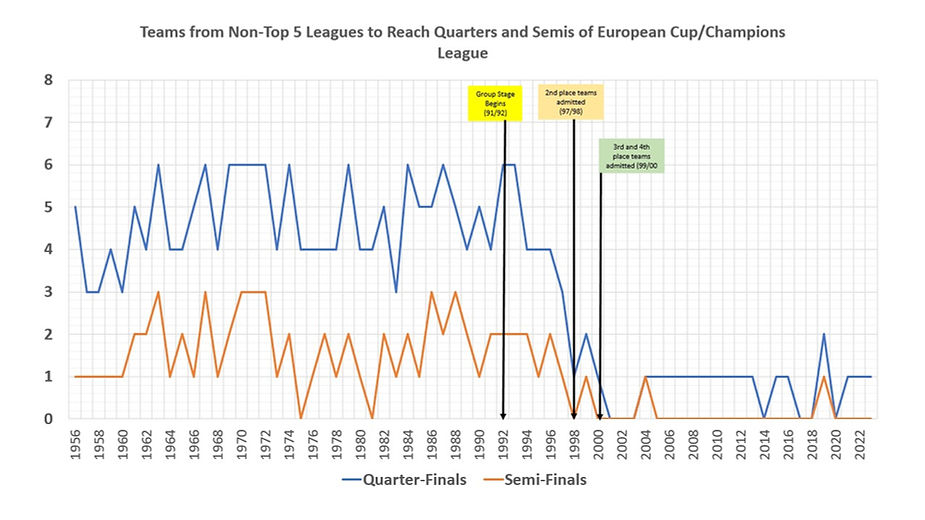
As we can see from the graph aboe, the implementation of the group stage between 1992 and 1997 had a gradual impact on the number of teams from outside the Big Five competing in the last eight and beyond. However, in 1992 we had a Big Five Final (Barcelona v Sampdoria) the first since Liverpool faced Juventus in the ill-fated game in 1985. Of course it should be remembered that England did not have representation from 1986 to 1991 and ultimately the luck of the draw dictates what is possible (precisely a chaotic element that the major clubs wanted to do as much to eliminate) so it is hard to draw firm conclusions but since that year only three times (1995, 1996 and 2004) has the final featured a team from outside the Big Five.
Though it's not apples to apples, Barcelona would have gone out to Sparta Prague in a knockout tie had the two been drawn together, based on results. In a group phase it was different and Barca progressed as group winners by virtue of performing better against Benfica and Dynamo Kyiv.
The following season however Barcelona were knocked out by CSKA Sofia in the knockout rounds before the group stages. The holders, eliminated by the Bulgarian Champions! The German Champions Stuttgart didn't even make it to the second round, going out to Leeds United, in a dramatic tie that required a third match due to the German's fielding of an ineligible player. Leeds themselves would lose to Rangers in the 'Battle of Britain'. Three of the representatives from the Big Five out before the groups began, yet the season would conclude with a final between Marseille of France and Milan of Italy. It's intriguing to consider who might have ended up in the final had the 1992/93 season continued in a straight knock-out format.
The year after (1993/94) Manchester United were eliminated by Galatasary but Milan and Barcelona would reach the final, defeating Monaco and Porto respectively in one-leg semi-finals. Milan did not win an away game in the group stage, a weakness that perhaps may have been exploited in a knockout tie. They tied both matches with Anderlecht 0-0 but gathered enough points elsewhere to progress.
Such early eliminations would be a thing of the past by the 1994/95 season via the subtle change that tipped the scales of the tournament further in favour of the big leagues with the top-seven ranked teams (plus the holders) admitted straight into the Champions League. The 'CSKA Sofia' banana skin had been removed and as we've already established, league formats benefit stronger teams.
Yet, 1994/95 was arguably the greatest Champions League season ever. Louis Van Gaal's terrific Ajax side would conquer Europe, in their famous win over Milan in Vienna. IFK Gothenburg topped a group featuring Barcelona and Man United. It may have been the perfect blend of high stakes group action, where every game counted with teams that were able to take points of each other. The financial gap between the big leagues was not so wide that it could not be closed with a well coached team and talented youth players as Ajax and Gothenburg proved. The Bosman ruling had not kicked in and teams could stay together for a few more seasons. It would not remain like this for much longer and though Ajax reached the final again in 1996, by 1997 the squad had been gutted and manager Van Gaal left to go to Barcelona.
But the biggest impact has been decision to allow non-Champions to participate in 1997. This broke a cardinal law of the competition. An element that is enshrined in the tournament's very name and trophy. The Coupe des Clubs Champions Européens. It's perhaps not a perfect comparison but would you allow B teams into the World Cup? Surely the French B or English team would be in the top 32 teams in the World, certainly they'd be in the top 24 in Europe. Wouldn't that enhance the competitive level of the World Cup or Euros?
This was consolidated in the 1999/00 season as the expansion to eight groups of four allowed for the potential of four teams from the major leagues.
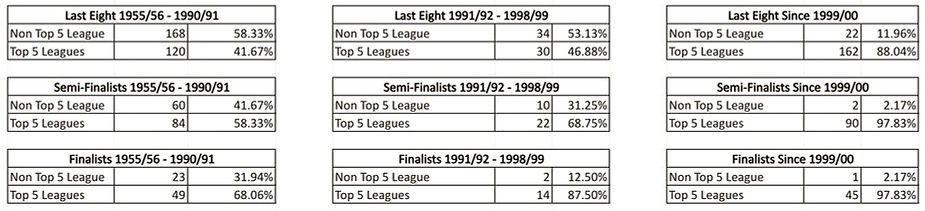
From the 1999/00 season onwards, 89 out of a possible 92 semi-finalists have come from the top five leagues (97.83%). Porto in their remarkable triumph under Jose Mourinho in 2004, PSV Eindhoven in 2005, and Ajax when they were so close to the final themselves in 2019 are the only three teams from outside the top five to reach the semi-finals. Let that sink in. Its not much better in regards to the Quarter Finals, only 22 times in 23 seasons (11% of all quarter-finalists) has a side reached the least eight. Effectively one a season. For Celtic, Feyenoord, Ajax, PSV, Red Star, Benfica, Porto all clubs with their names etched into the famous trophy, the chances of ONE of them reaching a semi-final are 1 in 50.
This week saw FC Copenhagen, PSV and Porto qualify for the last 16 as the three representatives outside the Big Five. For the Danes especially the achievement is magnificent and based on their displays so far they will give a positive account of themselves in the second-round. But that will likely be that. Next year they will likely still have to negotiate the play-in rounds to make it to the expanded 36 team group stage, yet the team they knocked out, Manchester United, could stand to benefit from a potential fifth guaranteed spot for English sides and end up right back where they the exited.
With such a small chance at ultimate success and a realistic height of ambition being a spot in the Quarter-Finals, teams have a geniuine question to ask. Is it better to qualify for the last 16 and a glamour tie or do you take your chance and drop into the Europa League and a better chance at glory? It is surely a sad indictment that that is even a question and worse still that for most the latter is the more logical choice.
There was much uproar about the European Super League project in 2021. All well intended and powerful. Unfortunately it already exists, we just weren't paying attention.
Cover Image: Salzburg fan display ahead of Liverpool Champions League tie in 2019 via Werner100359, CC BY-SA 4.0 <https://creativecommons.org/licenses/by-sa/4.0>, via Wikimedia Commons