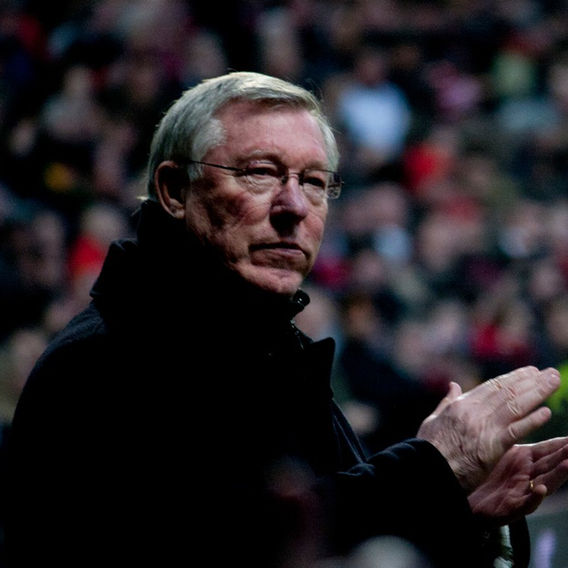
Sir Alex Ferguson cemented his legacy as one of the Greatest Football Managers of all time when he won the European Cup in 1999, completing The Treble in the process. His triumph in 2008 cemented his status, and he came close to lifting the trophy a third time only to run into FC Barcelona in their prime in 2009 and 2011.
Prior to his victory in the Nou Camp, Ferguson had had seven cracks at the biggest tournament in club football, three with Aberdeen. In Part One, here’s a rundown on the steep learning curve he endured at Aberdeen as he sought to emulate Jock Stein in leading a Scottish team to European Cup glory.
1980/81 Liverpool (Second Round)
Ferguson had led Aberdeen to an unlikely league triumph in his second season in charge at Pittodrie Stadium, only the club’s second championship in their history. After an impressive victory over Austria Vienna in the first round (1-0) they were drawn against the mighty Liverpool in the second round.
Demand for tickets was exceptional and it was estimated that the line for tickets at one point ran to 15,000. Capacity would be maxed at 24,000 with Pittodrie one of the few all-seater stadiums in Britain at the time.
The capacity crowd however were hushed when a superb team move was finished nonchalantly by Terry McDermott to put Liverpool 1 up inside five minutes. Ferguson was given a lesson by Bob Paisley, who allowed Aberdeen more of the ball but few chances and Liverpool left the Scottish North East with a valuable away goal and win.
Paisley alluded to Aberdeen’s naivety in his post-match comments stating: ‘We used to play like Aberdeen did in our early days in Europe. But we’ve learned that you can’t do this in two leg games. You have to change your tactics from league games’.
Aberdeen captain Willie Miller agreed, noting that: ‘We had a lot of the ball but didn’t do much with it. They didn’t have nearly as much – but they always looked more dangerous than us.’
Ferguson and his assistant Archie Knox had traveled down prior to the first leg to watch the Reds and were met by fellow Scot Bill Shankly. ‘So you’re down to have a look at our great team? Aye, they all try that’ remarked Shanks. It was not without truth, Liverpool had won the European Cup in 1977 and 1978. Indeed the trophy had not left England since their first win in ’77 and Liverpool were destined to clinch their third European Cup that year.
Ferguson was also facing a Liverpool team who had not lost in 75 home matches. It was to be night of harsh realities for the young manager and his team. In a fate that so many others before and after, Aberdeen were swallowed up by the Anfield roar and the quality of serial winners.
There was an even bigger competitive edge to Liverpool’s Scottish core of Graham Souness, Alan Hansen and Kenny Dalglish who sought to remind their countrymen of their qualities and the latter two would get themselves on the scoresheet in a resounding 4-0 win. As the Liverpool Echo noted, Ferguson’s Aberdeen were ‘outplayed, out-thought, out-run.’
Reflecting on the game in his Autobiography, Ferguson said: ‘All we could do was try to ensure that we learned from the painful exposure to proven masters of the techniques and discipline required in European competitions. Above all, our players had to appreciate that there is no forgiveness in such games for teams who surrender possession cheaply.’
1984/85 Dynamo Berlin (First Round)
Since the chastening defeat to Liverpool, Ferguson had certainly applied some of those lessons to his European performances and by the time he next had a shot at becoming Kings of Europe, he had added two European trophies to his CV. In season 1981/82 he took Aberdeen to the third round of the UEFA Cup where they exited to eventual finalists Hamburg SV.
The following year he would secure one of his most remarkable achievements in management, defeating Real Madrid in the final of the Cup Winners Cup, before adding the Super Cup later that year. This would be followed up by a semi-final defeat to Porto in the Cup Winner’s Cup in 1983/84.
Expectations were therefore fairly high as Aberdeen entered the 1984/85 European Cup but it would prove to be another disappointing display for Ferguson’s side as they exited in the first round to East German Champions Dynamo Berlin.
Dynamo were in the middle of a run of ten successive East German titles and had reached the quarter-finals the year previous. Their domestic success wasn’t without controversy. Erich Meilke, chief of the Stasi sat on ther board as honorary chairman and his influence ensured Dynamo had access to the best players and facilities the GDR had to offer.
It was a tricky draw for sure but Aberdeen had defeated Bayern Munich and Hamburg the Dons showed how far they had come since the Liverpool defeat and how fat they still had to go. Leading 2-0 at home after a double from Eric Black, they conceded a late away goal with eight minutes remaining.
Behind the Iron Curtain it was a similar story. Drawing 1-1 on the night, they conceded another late goal, this time with six minutes left of play sending the match into extra-time and subsequently penalties.
Again Ferguson’s men would grasp defeat from the jaws of victory. Two of the teams most important players would be the culprits x Captain Willie Miller (squandering chance to win the tie) and Eric Black (in sudden death) both having their kicks saved by Bodo Rudwaleit.
The defeat coincided with a shock league cup exit to Airdrie but like so many of Ferguson’s teams Aberdeen stepped up a gear after Christmas and would end the season with a league and cup double.
1985/86 IFK Gothenburg (Quarter-Finals)
The 85/86 season was a pivotal year for Ferguson and Aberdeen. It would see them and him reach the last eight in the European Cup for the first time but it would also be the year he realised his ambitions were too big for Aberdeen.
In his autobiography Ferguson complained about an attendance of 17,000 stating that ‘It crossed my mind that perhaps the Aberdeen supporters were spoiled and took success for granted, and the suspicion planted seeds of restlessness in me.’
The attendance however was reported as 22,000 (a full house), its possible Ferguson was confusing the match with the round previous, where Aberdeen had defeated Servette in front of 18,000. A goal from Frank McDougall was enough to eliminate the Swiss over two legs on that occasion. Akranes of Iceland had been eliminated in the first round.
English sides had won the tournament in seven of the previous nine years but were banned from participation following the Heysel tragedy the previous May. There was a significant opportunity for an outsider to win the competition (and so it ultimately proved) and Ferguson clearly felt it could be Aberdeen.
They would start well against IFK going ahead trough captain Willie Miller. Normally the stalwart of the back line, Miller found himself in the left wing position and finished ruthlessly to put the Dons ahead. After Tommy Holmgren had got the Swedes level, John Hewitt, hero of Gothenburg, got on the end of a punt from Bryan Gunn and looked to have gotten Aberdeen one step closer to the semi-finals.
But just like the previous year, and the opposite of Ferguson’s later trademark, Aberdeen conceded another crucial away goal. The lightning quick Johnny Ekström, got on the end of a through ball and there was no catching him as he rounded Gunn.
Back at the scene of their finest hour, the Ullevi Stadium, Gothenburg put on a professional performance to see the game out and Aberdeen rarely threatened. The damage had been done in the home tie. Within six months Ferguson was off to Manchester. Aberdeen have yet to return to the tournament.
 Gavin MacPhee
Leave a Reply